Key Points
- Both Republican candidate Representative Byron Donalds and Democratic nominee David Jolly held campaign stops across Tallahassee, Florida, just one week ahead of election day.
- Recent polling shows the Florida gubernatorial contest remains significantly tighter than other recent statewide races in the state.
- Representative Byron Donalds retains structural advantages, including strong national party backing, conservative-led state alignment, and robust fundraising capabilities.
- Democratic nominee David Jolly is focusing his platform on expanding public school funding, expanding Medicaid, restoring scientific oversight in public health, and removing State Surgeon General Joseph Ladapo.
- Campaign stops by both candidates in Leon County and across the Florida Panhandle reflect strategic efforts to mobilize core supporters while attempting to appeal to swing voters in traditionally opposing territories.
Tallahassee, Florida (Florida Repot Daily) October 28, 2026 – Executive Summary: Republican Representative Byron Donalds and Democratic candidate David Jolly made simultaneous campaign appearances in Tallahassee on Tuesday as both camps work to widen their electoral reach in the final week before election day. Despite structural advantages benefiting Donalds in a historically conservative-leaning state, current polls indicate a remarkably narrow margin between the two contenders. Both campaigns are making late pushes across the Florida Panhandle to engage base voters and capture swing electors in non-traditional territory.
- Key Points
- Why Are Byron Donalds and David Jolly Campaigning in Tallahassee?
- How Are the Candidates Targeting Voters Across the Florida Panhandle?
- What Key Issues Is David Jolly Emphasising on the Campaign Trail?
- Background of the Particular Development
- Prediction: How Will This Development Affect Florida Voters and the Electorate?
Why Are Byron Donalds and David Jolly Campaigning in Tallahassee?
As reported by Gary Fineout of POLITICO, the state capital of Florida is accustomed to hosting politicians from across the political spectrum, yet it remains exceptional for gubernatorial candidates from both major parties to cross paths in the city just seven days before an election.
Republican Representative Byron Donalds and Democratic nominee David Jolly presented their platforms to local crowds in Tallahassee on Tuesday. The city serves as a distinct Democratic-leaning jurisdiction situated within the largely conservative geographic expanse of northern Florida. The campaign visits underscore a race where Democrats maintain confidence in turnout among their regional base, while Republicans seek to erode traditional Democratic voting strongholds.
As reported by Gary Fineout of POLITICO, recent public opinion surveys indicate that the gubernatorial race is noticeably tighter than other statewide contests in Florida in recent election cycles. This narrowing occurs despite structural factors favoring Representative Donalds, including substantial national party support, a conservative-led state environment, and a distinct fundraising surplus. Consequently, campaign stops in Tallahassee by both Donalds and Jolly provide a dual opportunity: securing the engagement of core base voters while appealing to electors who remain flippable in the final stretch.
How Are the Candidates Targeting Voters Across the Florida Panhandle?
As reported by Gary Fineout of POLITICO, both candidates have executed campaign stops throughout the Florida Panhandle in recent days, coinciding with the full rollout of early voting options across the state.
Both Donalds and Jolly visited regions known for high concentrations of registered Republican voters, including Pensacola and Panama City, before Representative Donalds arrived on his campaign bus on Tuesday morning at a local sports bar located on the suburban eastern side of Tallahassee.
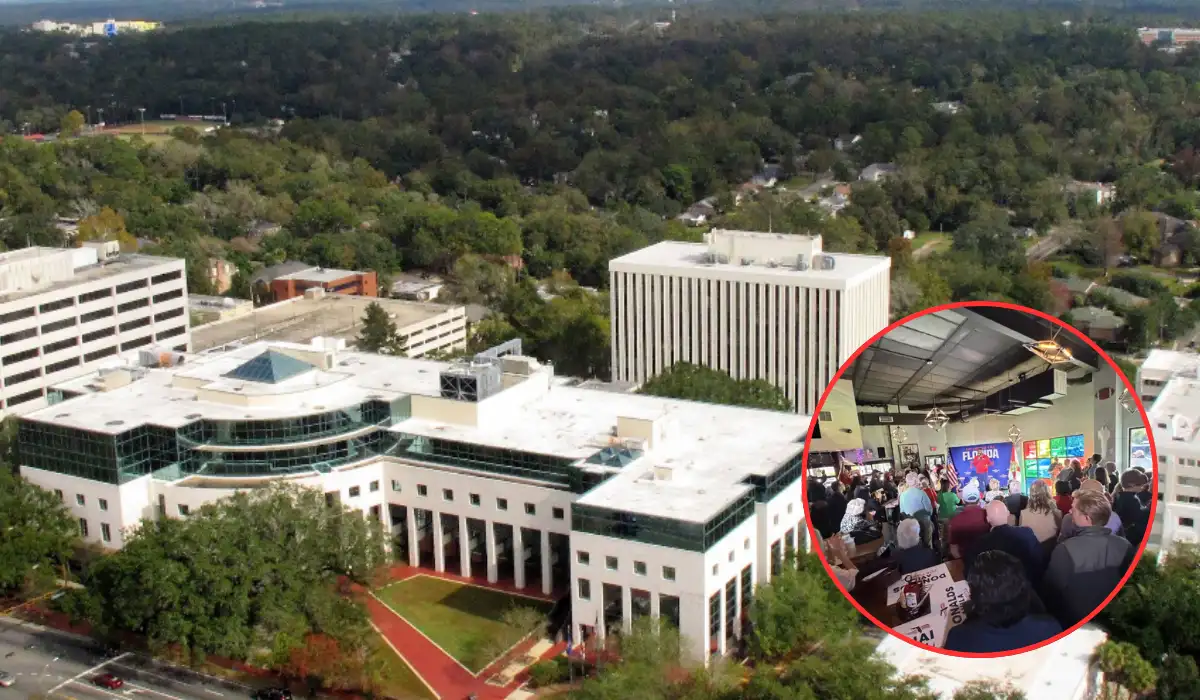
Unlike the broader Panhandle, Leon County—where Tallahassee is situated—maintains a voter registration advantage of at least 30,000 more registered Democrats than Republicans. Due to this voter distribution, many Republican statewide candidates typically elect to spend critical late-stage campaign hours in other regions of Florida. However, Donalds addressed a crowd composed of retirees, business owners, and local lobbyists gathered at Bumpa’s Local 349.
Upon stepping onto the stage and observing the gathering, Representative Donalds remarked on the turnout, asking: “This is Tallahassee? Oh I like this.”
As reported by Gary Fineout of POLITICO, supporters attending the Donalds event noted that they were familiar with the candidate well before his first successful campaign for a Naples-based seat in the Florida House of Representatives in 2016. Addressing the venue, Representative Donalds recounted his initial arrival in the state capital, noting that his first experience in Florida occurred when he stepped off a Greyhound bus in downtown Tallahassee.
Representative Donalds stated to the audience: “When I tell people about how I love this state, it’s because everything that I’ve been able to do in my life has been done in Florida.”
What Key Issues Is David Jolly Emphasising on the Campaign Trail?
As reported by Gary Fineout of POLITICO, while both Donalds and Jolly have made previous visits to the capital city during this election cycle, the audience assembled at David Jolly’s rally delivered enthusiastic responses as he outlined his proposed policy agenda.
Jolly detailed core campaign commitments, which include increasing state financial allocations to public schools, enacting an expansion of Medicaid, and restoring scientific principles to state public health administration.
Furthermore, Jolly drew substantial applause from supporters when he pledged to end the tenure of Florida State Surgeon General Joseph Ladapo as head of the Florida Department of Health. Dr Ladapo, who was appointed to the post by Governor Ron DeSantis, has faced sustained criticism from Democratic lawmakers and public health figures over his skepticism regarding vaccine efficacy and public health mandates.
Background of the Particular Development
The late-stage campaigning in Leon County reflects significant structural realignments within Florida’s political landscape over recent election cycles. Following years of thin margins in statewide races, Florida shifted toward broader Republican margins in major contests, supported by shifts in voter registration metrics and strong party infrastructure statewide.
However, the 2026 gubernatorial contest has demonstrated unique competitiveness. The Democratic entry of former Republican U.S. Representative David Jolly introduced a candidate with cross-party name recognition, while Representative Byron Donalds advanced through the Republican primary with strong national backing and alignment with conservative leadership.
Leon County has historically served as a central Democratic anchor in North Florida, surrounded by heavily Republican rural counties across the Panhandle. Campaigning directly in urban blue enclaves within red regions—and vice versa—represents a tactical effort by both political organizations to maximize total vote yields under high early-voting turnout conditions.
Prediction: How Will This Development Affect Florida Voters and the Electorate?
The decision by both gubernatorial campaigns to expand their geographical focus into non-traditional strongholds during the final week of campaigning is expected to directly impact voter engagement and turnout dynamics across several distinct voting blocks in Florida.
For Democratic voters in Leon County and similar urban centers across northern Florida, direct campaign visits and explicit commitments on healthcare, public school funding, and public health governance are likely to bolster voter enthusiasm. By promising structural changes to state health leadership and education budgets, the Jolly campaign aims to drive higher turnout among base voters who might otherwise feel isolated within a predominantly conservative regional landscape.
For Republican and conservative-leaning independent voters in suburban and rural areas, Representative Donalds’ presence in traditionally Democratic territory demonstrates an active campaign strategy to contest every region of the state. This direct outreach may encourage higher participation among suburban retirees and business owners in Leon County, potentially narrowing the margin loss for Republicans in urban centers while maintaining strong advantages in surrounding Panhandle counties.
Finally, for unaffiliated and moderate voters statewide, the tightening poll numbers and active multi-region campaigning signal a highly competitive contest. The focus on local economic issues, healthcare accessibility, and public administration may encourage higher overall participation in early voting and election day balloting across Florida.